Myfanwy’s Decision to Take Over Her Former Life
The RookMyfanwy’s decision to take over her former life is a turning point in which immediate escape gives way to the pursuit of answers. Her former self offers two sharply different futures: leave the country with the resources to begin again, or open 1011-B and reclaim a dangerous life marked by betrayal. The amnesiac Myfanwy initially chooses escape, but events at the bank and a letter that recognizes her emerging power redirect her toward the identity she had meant to abandon.
The Choice Set Out in the Letters
The decision is framed by the former Myfanwy as hers to make, not as an obligation imposed by the writer. Box 1011-A holds materials for leaving and building a new identity; 1011-B is the route back into the life of Myfanwy Thomas. The writer emphasizes that the body comes with substantial money and that the escape plan includes instructions, names, and facts meant to help make a new existence safer. Even so, she cannot promise complete security.
The alternative is not presented as safe. Taking up the former Myfanwy’s life would offer wealth, power, and knowledge, but it would also expose the successor to the danger behind the betrayal. The letter describes the injustice as shared: the new occupant has done nothing to deserve what is happening, while the former Myfanwy cannot believe she herself has done anything to warrant it. The warning that someone wants her dead makes the choice urgent, while the two keys leave its outcome in her hands.
Flight Before the Reversal
The amnesiac Myfanwy initially rejects the appeal of the former life. She regards its promised privileges as no reason to accept danger and decides that common sense means getting away from people trying to kill her. She firmly circles 1011-A. Her first decision is therefore not a simple failure to understand the stakes: it is a deliberate preference for distance, money, and the possibility of a life not dictated by an unknown predecessor.
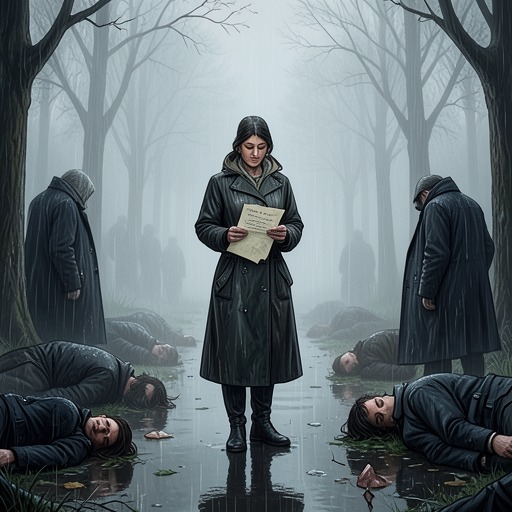
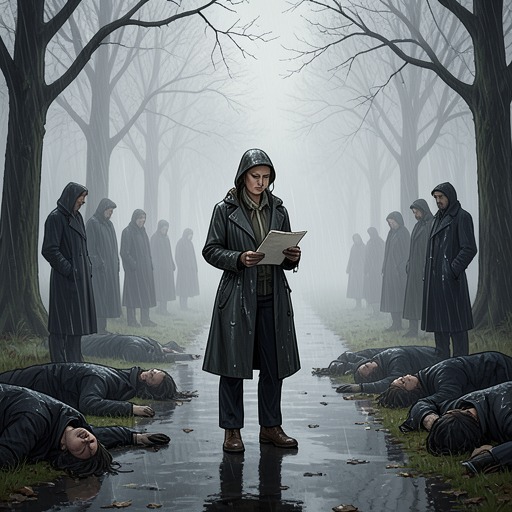
That plan is interrupted when she reaches the bank. After an attack leaves people on the floor, she recognizes that the assumptions she had formed about Myfanwy Thomas and the events around her cannot be trusted. Rather than simply flee, she decides that she wants to understand the world she has encountered. She finds the correct keys among the bank’s numbered compartments, reaches the lockboxes, and, looking back at the people lying there, opens 1011-B.
What 1011-B Contains
The box does not provide an immediate, orderly explanation. It contains two suitcases: one holding objects wrapped in bubble wrap, the other stacks of numbered envelopes written in the former Myfanwy’s unmistakable hand. The contrast matters. The amnesiac Myfanwy had not known what to expect and is first disappointed that she has found paperwork rather than conspicuously valuable or technological objects. Curiosity follows, but she decides that reading can wait and takes the cases with her.
The first letter she opens explains why the former Myfanwy expected this choice to be unlikely. She assumes the reader would normally prefer the apparent certainty of a new life to vague warnings. But she also anticipates that the successor may have experienced a sudden manifestation of power: under severe stress, contact with another person’s skin can paralyze, blind, silence, or otherwise affect that person. The letter treats this experience as a decisive opening into the former life, and welcomes the choice of 1011-B even if the reader had originally intended to choose the other box.
The note gives the next step rather than a complete account of the past. It instructs Myfanwy to take both suitcases to an address, use the enclosed key, and open the next envelope once established there. The destination is not associated with her driving licences and is described as a flat; the letter says it has no official connection to the former Myfanwy and should be approached without being followed. Thus, choosing the old life begins not with instant recognition but with a sequence of documents, precautions, and decisions.
Consequences and Significance
The choice changes the direction of Myfanwy’s response to danger. At first, she sees the former identity as a liability she can avoid by using the money and instructions to leave. The bank attack makes that retreat less straightforward: her existing beliefs have proved unreliable, and the box she opens contains evidence that her predecessor prepared for a successor who might continue the investigation. Her decision is consequently both practical and epistemic. She accepts greater exposure because escape alone cannot answer what has happened or why she is being targeted.
The event also establishes the tension between identity and memory that shapes Myfanwy’s story. She can inherit the name, body, resources, and accumulated plans of Myfanwy Thomas without remembering the experiences that made them hers. The letters bridge that gap, but they cannot make the decision for her; their author explicitly leaves the choice open. Opening 1011-B is therefore not a recovery of the former self so much as the beginning of a new person’s deliberate engagement with an inherited life.
That decision also returns the plot to the Checquy’s longer conflict with the Grafters. The letters’ historical account describes the 1677 invasion of the Isle of Wight, when the Checquy fought for three weeks against Grafter creations, losing hundreds of civilians and many soldiers. The conflict ended after Rook John Perry joined his mind to that of the Grafter general and killed them both. The subsequent treaty required the Belgian ruler to dissolve the Grafters, and the Checquy believed the organization had been dismantled. Much later, Graaf Ernst von Suchtlen explains that the Grafters’ goal was not invasion: they could not make a conquest public without exposing the secret supernatural world, which the Checquy also sought to protect. Myfanwy’s choice to pursue her former life thus opens onto a danger shaped by concealed history, not merely a private attack.
In that later confrontation, Myfanwy recognizes that an open war would be difficult to conceal and would violate the Checquy’s mandate to protect in secrecy. Graaf Ernst explains that his hostility toward the Checquy had changed over generations: he came to regard it as a flawed but potentially effective governing body and pursued infiltration and collaborators to make a merger appear advantageous. This later disclosure recasts the danger behind the original choice. Myfanwy’s return to her former life leads not only toward identifying betrayal, but toward deciding how an old conflict might be changed without exposing the hidden world it has long shaped.